Last updated July 1, 2026 | Written for first-time Sudoku players using printable or online grids.
How to Play Sudoku
To play Sudoku you need to fill every square with a number from 1 to 9.
Each row each column and each 3x3 box must have the numbers 1-9 once.
The trick to Sudoku is not about doing math it's about eliminating numbers that can't go in a cell until theres one possible answer left.
When you start your puzzle don't try to solve it from left to right like you would a crossword.
Sudoku is actually easier when you look for the rows, columns and boxes that already have a lot of numbers filled in.
Then you can place the numbers that're the only ones that can go in certain cells.
As you get clues you can keep moving and filling in more numbers.
If you're making a worksheet for a first puzzle use one puzzle per page and have the person solve it in pencil.
The extra space, around the puzzle is helpful because notes can get messy quickly on grids.
This makes it easier to keep track of your progress and think through the puzzle.
Sudoku Rules in One Minute
Classic Sudoku is a puzzle that has a 9x9 grid with 81 cells. Some of these cells already have numbers in them. These are called the givens. Your task is to fill in the cells without breaking any of the rules of Classic Sudoku.
To play Classic Sudoku you use the digits 1 through 9. Each empty cell in the Classic Sudoku grid gets one of these digits. You cannot use zero. Repeat any digits or use any arithmetic symbols in Classic Sudoku.
There are a rules to follow in Classic Sudoku.
- No repeats in a row: each row in the Classic Sudoku grid must have the numbers 1, 2 3 4 5 6 7 8 and 9. Each of these numbers can only be used once in each row of the Classic Sudoku grid.
- No repeats in a column: this rule is the same as the row rule. It applies to the columns in the Classic Sudoku grid. Each column in the Classic Sudoku grid must have the numbers 1 through 9. Each number can only be used once in each column of the Classic Sudoku grid.
- No repeats in a 3x3 box: the Classic Sudoku grid is divided into 3x3 boxes and each of these boxes must also have the numbers 1 through 9 with no repeats in each 3x3 box of the Classic Sudoku grid.
- Do not change the givens: the numbers that are already filled in when you start the Classic Sudoku puzzle are. You should not change them. You can only fill in the cells in the Classic Sudoku grid.
- Use logic, not guessing: a good Classic Sudoku puzzle should let you figure out the answer to each cell by using logic and by checking the row, column and 3x3 box of the Classic Sudoku grid.
When you finish the Classic Sudoku puzzle it should be correct with no digits in any row, column or 3x3 box of the Classic Sudoku grid. If you find that one of the rows has two of the number, like two 4s then the Classic Sudoku puzzle is wrong even if the columns look okay.
Learn the Grid Before You Solve
Every empty cell belongs to three overlapping areas at the same time: one row, one column, and one 3x3 box. Sudoku players often call those areas "houses." A number is legal only when it fits all three houses.
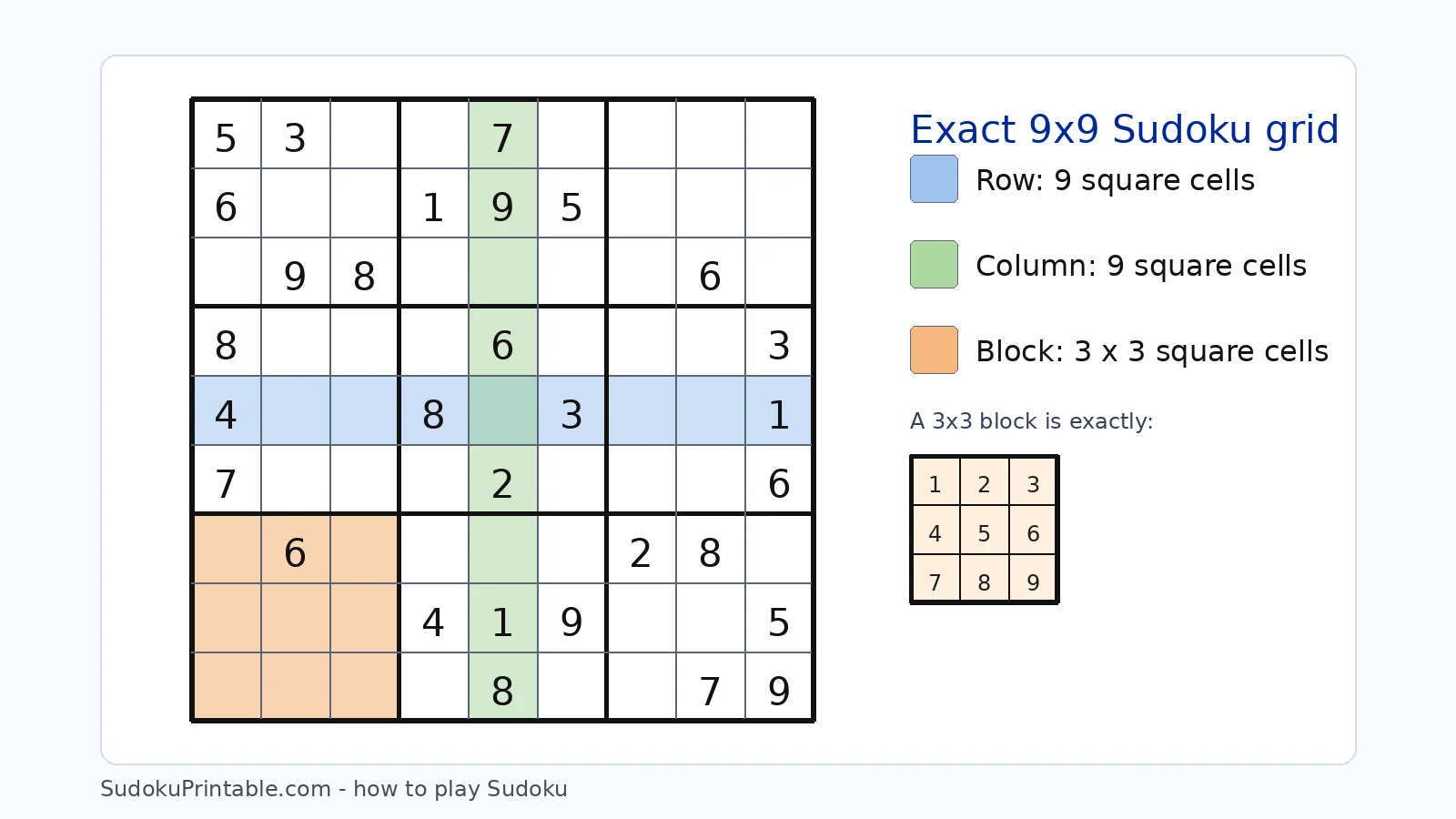
Helpful Sudoku vocabulary
- Cell
- One square in the 9x9 grid.
- Given
- A starting number printed in the puzzle. Do not change it.
- Candidate
- A possible digit that might fit an empty cell.
- Box or block
- One of the nine 3x3 regions inside the full grid.
- Peer
- Any cell sharing the same row, column, or box with your target cell.
How to Solve Your First Sudoku Puzzle Step by Step
Use this routine for your first several puzzles. It is deliberately slower than guessing, but it teaches the habits that make harder puzzles possible later.
- Choose an easy grid and set up your page
Start with an easy puzzle, a pencil, and enough space for notes. On paper, one puzzle per page is the friendliest first format because tiny candidate notes are easier to read.
- Scan for crowded rows, columns, and boxes
Look for any area that already has five, six, seven, or eight filled cells. The more clues an area has, the fewer missing digits you need to compare.
- List the missing digits
If a row contains 1, 2, 4, 5, 6, 8, and 9, then only 3 and 7 are missing. You do not need to solve the whole puzzle at once. Solve one small question at a time.
- Check each empty cell against its row, column, and box
A digit is allowed only if it is absent from all three areas. If a 7 is already in the same column, that cell cannot be 7 even when the row still needs 7.
- Place numbers only when the answer is forced
If one cell has only one valid candidate, place it. If one digit has only one possible place in a row, column, or box, place it there.
- Update the rest of the puzzle after every placement
Every confirmed number changes the grid. After you place a 5, remove 5 from candidates in the same row, column, and box, then scan again for new singles.
- Move around instead of staring at one blank
If a cell still has two or three options, leave it. The easiest next move is often in another box that became clearer because of a number you just placed.
The practical rhythm is: scan, eliminate, place, update, repeat. When that rhythm stops producing answers, switch areas rather than forcing a guess.
Example: How Elimination Works
In the example below, the highlighted cell cannot be solved yet. That is useful to notice. Good Sudoku solving is partly knowing when not to write a final number.
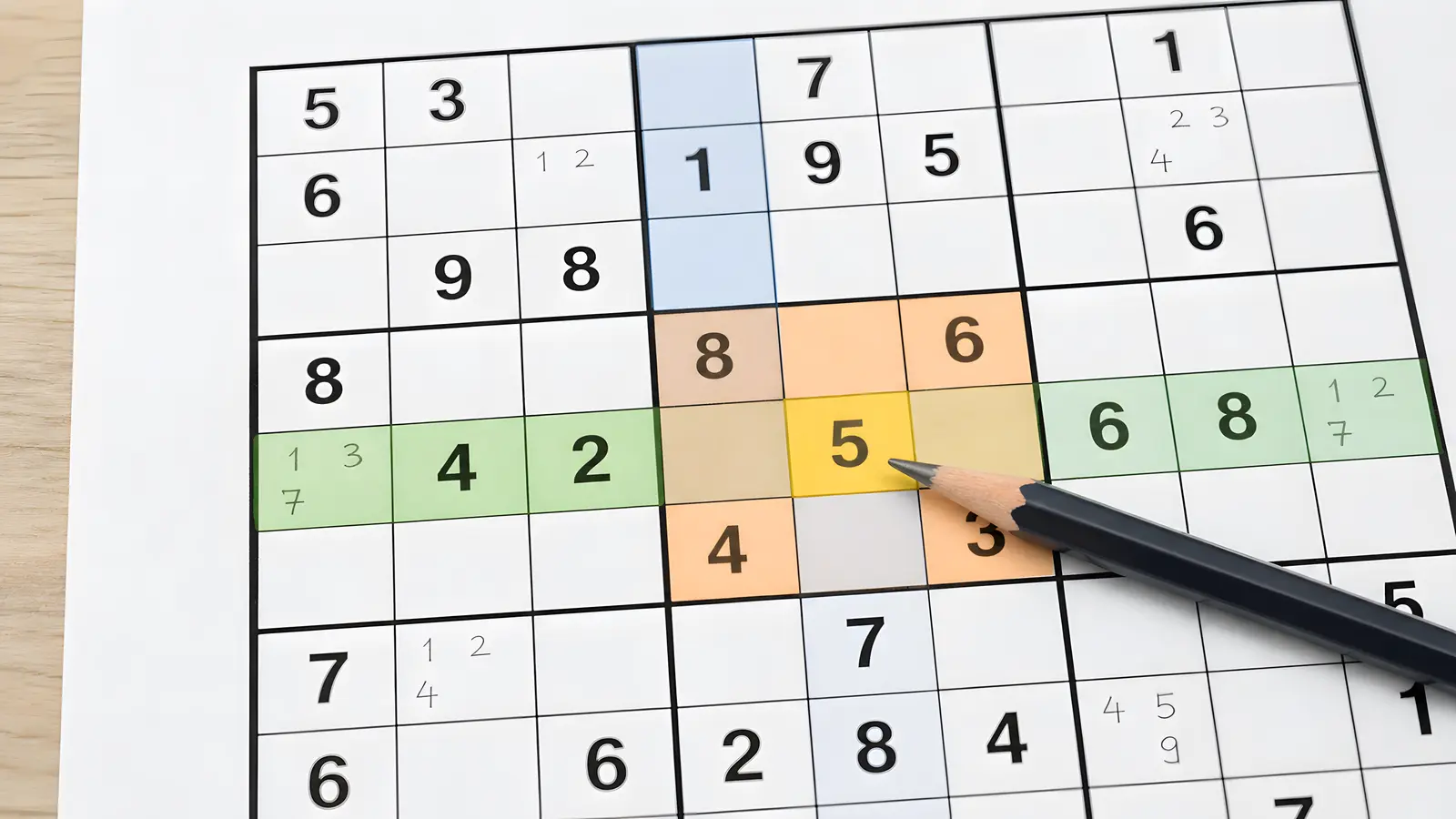
This is the point where many beginners guess. Do not. Mark the candidates if you need them, then scan another row or box. Later, a confirmed 2, 4, or 7 in a peer cell will remove one of those options.
Practice grid
| 4 | 5 | 7 | ||||||
| 8 | 9 | 2 | 7 | |||||
| 7 | 2 | 1 | 5 | 9 | ||||
| 8 | 2 | 1 | 7 | |||||
| 7 | ||||||||
| 8 | 3 | 1 | 5 | |||||
| 9 | 6 | 4 | 3 | 1 | 2 | |||
| 1 | 2 | 7 | 9 | 3 | 8 | |||
| 5 | 8 | 7 | 2 | 1 | 9 | 4 |
Try this scan
Look at the top-left 3x3 box. It already contains 2, 4, 7, 8, and 9, so it still needs 1, 3, 5, and 6. Some blanks in that box can be narrowed further by checking their rows and columns.
You may not place a final answer immediately, and that is normal. A clean candidate list is progress.
Print an easy puzzle and practice this one-box scan before trying a full speed solve.
How to Use Pencil Marks Without Making a Mess
Pencil marks are small temporary candidate numbers. Use them when a cell has two or more possible answers. They are especially helpful on medium puzzles and above, but beginners should learn them early.
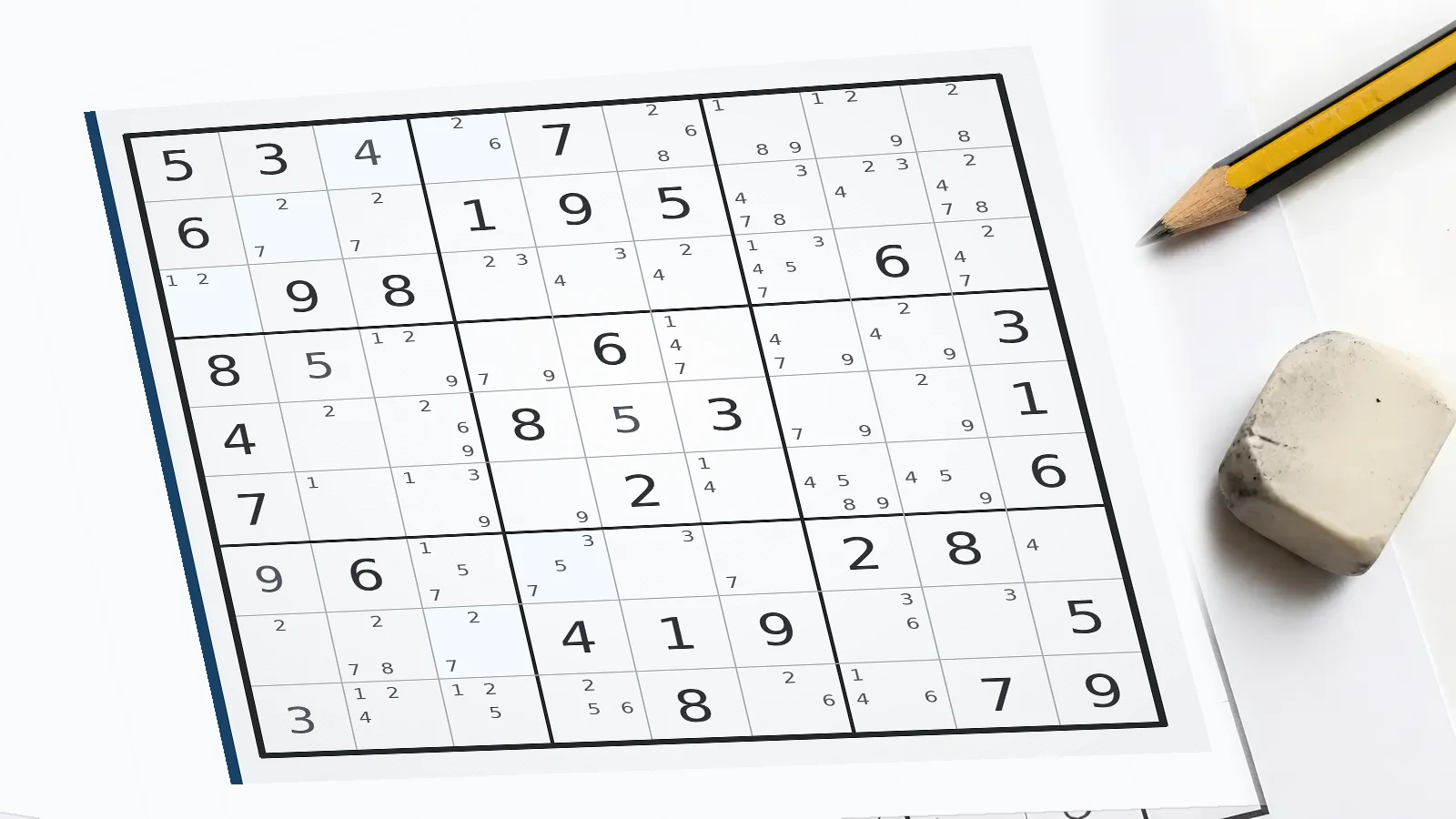
A clean note system
- Write candidates in numeric order, such as 2 4 7, so every cell is easy to compare.
- Keep candidates small and final answers large.
- Erase a candidate from all peer cells after you place that digit.
- If playing online, use notes mode for candidates and normal mode for final answers.
- If your notes fill most cells, pause and look for hidden singles before adding more marks.
Beginner Techniques You Actually Need First
For your first few puzzles, focus on the techniques below. They solve many easy grids and prepare you for the full Sudoku strategy guide.
| Technique | What it means | How to use it |
|---|---|---|
| Last free cell | An area has eight filled cells and one blank. | Find the missing digit from 1-9 and place it in the blank cell. |
| Naked single | A cell has only one possible candidate after row, column, and box checks. | Write the only remaining digit in that cell. |
| Hidden single | A digit can go in only one place within a row, column, or box, even if that cell has other pencil marks. | Scan one digit at a time, especially inside 3x3 boxes. |
| Cross-hatching | Existing copies of a digit cross out rows and columns inside a 3x3 box. | Pick one digit, look at nearby boxes, and mark where that digit cannot go. |
| Candidate cleanup | Pencil marks become outdated after each confirmed placement. | Erase that digit from every peer cell in the same row, column, and box. |
How to Pick the Right Difficulty
Difficulty is not just the number of starting clues. Two puzzles can have the same clue count but very different solving paths. Choose by the logic required, not only by how full the grid looks.
| Level | Best for | What to expect |
|---|---|---|
| Easy | First puzzles, warmups, classroom practice, and learning rules. | Expect many direct singles and obvious missing numbers. |
| Medium | Daily practice after the rules feel comfortable. | You will use more pencil marks and hidden singles. |
| Hard | Solvers who can track candidates without losing the thread. | Progress may require pairs, pointing logic, and more patient scanning. |
| Expert and extreme | Experienced solvers who enjoy long candidate chains. | Not the right starting point for learning the basic game. |
If you are printing for a class, a senior group, or a family game night, start with easy Sudoku and include solutions. For solo practice, move to medium only after you can finish easy puzzles without guessing.
Printable Sudoku Setup Tips
Printable Sudoku feels different from an app because you manage your own notes, erasing, and checking. That is part of the appeal, but the setup matters.
- Use large print Sudoku if you write big notes or solve with someone across the table.
- Use four puzzles per page for practice packets after you understand the rules.
- Use a blank Sudoku grid to copy newspaper puzzles, teach examples, or restart a messy solve.
- Print solution pages when puzzles are for groups, travel folders, substitutes, or independent practice.
- Keep one margin area for abandoned candidates or "come back later" notes instead of squeezing them into cells.
You can also use the Sudoku generator to choose difficulty, paper size, puzzles per page, and whether answer pages are included.
How to Check Your Work
Do a quick audit before calling a puzzle finished. This catches nearly every beginner mistake.
- Scan each row. Every row should contain 1-9 exactly once.
- Scan each column. No repeated digit should appear vertically.
- Scan each 3x3 box. Each box should also contain 1-9 exactly once.
- Compare any uncertain cells with your pencil marks. If a final answer contradicts a peer cell, fix it before continuing.
- If you are fully stuck, enter the givens into the Sudoku solver to check whether the puzzle is valid or to inspect the completed grid.
Common Beginner Mistakes
| Mistake | Better habit |
|---|---|
| Starting in the top-left corner automatically | Start wherever the puzzle gives you the most information, even if that is the middle or bottom row. |
| Writing candidates too large | Keep pencil marks small and in a consistent order. On printed grids, cramped notes are the fastest way to misread your own work. |
| Guessing between two numbers | Leave both candidates and solve somewhere else. A later placement will usually remove one option. |
| Forgetting the 3x3 box rule | Check the box every time. Many beginner errors happen when the row and column look legal but the box already has the digit. |
| Not rechecking after a placement | Ask: what changed? One confirmed digit can unlock several nearby cells. |
Watch a Short Sudoku Rules Video
If the grid still feels abstract, watch the short rules video below, then come back and solve one easy printable puzzle with a pencil. Notice how the video explains the same three checks: row, column, and box.
If the embed is blocked, open the tutorial on YouTube.
Further Learning and Sources
Once you know the rules, use these links to keep practicing and to compare solving explanations from established puzzle publishers.
- Daily Sudoku: a new puzzle each day on SudokuPrintable.com.
- Sudoku rules: a shorter rules-only reference.
- Sudoku tips: practical solving and printing advice.
- Nikoli Sudoku history: background from the Japanese publisher that popularized the name Sudoku.
- Conceptis Sudoku techniques: a deeper list of scanning and candidate methods.
- World Puzzle Federation Grand Prix rules: useful context for paper-solving and competitive Sudoku formats.
Treat broad "brain training" claims carefully. Sudoku exercises attention, logic, and pattern recognition while you play, but it is a puzzle, not medical treatment.