Last updated July 1, 2026 | Every diagram below comes from a real, unedited puzzle in our pools, with its ID printed under the image.
Sudoku Tips & Tricks
Two moves finish most Sudoku puzzles: naked singles and hidden singles.
We checked this against our own puzzles. In 150-puzzle samples from each of our five 1,000-puzzle pools, singles alone completed 99% of easy grids and 89% of medium grids, but only 57% of hard, 31% of expert, and 24% of extreme.
In other words, the techniques form a ladder. Scanning and singles handle easy and medium puzzles. Hard grids add pairs and pointing eliminations. Expert and extreme grids call for bigger patterns like the X-Wing. This page teaches 19 techniques from easiest to hardest and shows four of them on real puzzles from this site. It also covers the step most guides skip: how to keep track of everything in pencil on paper.
If you have never solved a grid before, start with the how to play Sudoku guide and come back. Everything here assumes you know the row, column, and box rules.
Scan First, Write Second
Before touching a pencil, count the givens per digit. A digit that appears seven times has two placements left, and both are usually forced. A digit that appears twice is not worth chasing yet. This one habit, scanning by digit instead of staring at empty cells, is the biggest single upgrade a beginner can make.
Cross-hatching
Cross-hatching is scanning made mechanical. Pick one digit and one box that lacks it. Every existing copy of that digit blocks its full row or column, including the part passing through your box. Whatever cells survive are the digit's only options there.
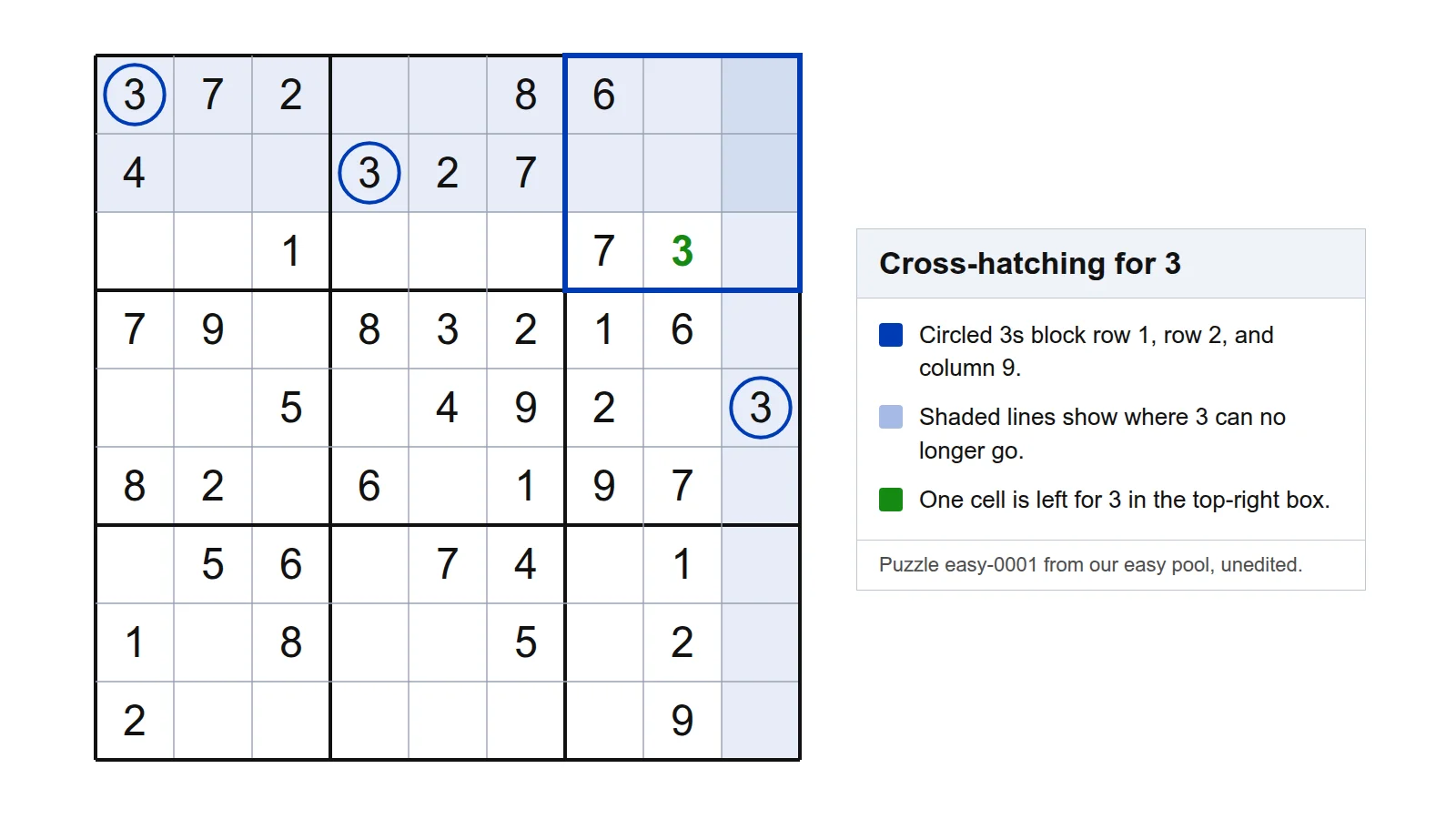
In the example above, the top-right box has seven empty cells, which sounds hopeless. But the 3 in row 1 removes two of them, the 3 in row 2 removes three more, and the 3 in column 9 removes the last spare. Only one cell survives, so it takes the 3. Seven candidates collapsed to one without a single pencil mark.
The four beginner moves
- Last free cell: a unit with eight filled cells gets the ninth digit automatically. Zero thought required, so collect these first.
- The 45 subtraction: every unit sums to 45. With one blank, add the filled cells and subtract from 45. Faster than scanning when a row is nearly done, and the same arithmetic later powers Killer Sudoku.
- Naked single: a cell whose row, column, and box already contain eight different digits can only hold the ninth. Our easy grids open with about seven of these sitting on the printed page; extreme grids average under one.
- Hidden single: a digit with only one possible cell left in a unit, even if that cell has other candidates. Cross-hatching is how you find them box by box.
Those four moves, cycled until they stop producing, are the whole game at easy and most of medium. Print a few easy grids and run nothing but this cycle; when an easy puzzle no longer stalls you, the techniques below start making sense.
Pencil Marks That Work on Paper
Most technique guides assume an app with a notes button and infinite erasing. On a printed grid, marks cost real space and real eraser wear, so the marking system matters more than any single technique.
There are two systems worth knowing.
- Center marks (full candidates): write every digit a cell can hold, small, in numeric order. This is the notation the diagrams on this page use, and it is what pairs, triples, and fish are read from. The cost: on a 24-given extreme grid you may be maintaining 150+ tiny numbers.
- Corner marks (Snyder notation): mark a digit in a cell's corner only when that digit has exactly two possible cells in the box. Named for Thomas Snyder, a three-time World Sudoku Champion, and popular with speed solvers because it tracks the information that actually resolves boxes while writing a fraction of the numbers.
Our advice after years of printing these: Snyder corners for anything up to hard, full center marks only when an expert or extreme grid stalls. Full candidates on a medium grid are mostly wasted motion; singles finish 89% of them without a single written mark.
Paper-specific habits that pay off:
- Keep marks in a consistent order (always 1 to 9) so a missing digit is visible at a glance.
- After each placement, erase that digit's marks from the three affected units immediately. Stale marks are the top source of wrong answers on paper.
- Solving in pen? Strike dead candidates through with one clean line, and park uncertain deductions in the margin.
- Use large print grids if your marks crowd the cells, and one puzzle per page for expert and extreme, where the mark load is heaviest.
- Keep a blank grid nearby to rebuild a section that turned to mush, rather than erasing through the paper.
Intermediate Techniques: Pairs and Pointing
Everything in this tier works by crossing candidates out. That feels like slower progress than writing digits, but each elimination feeds the singles cycle, and usually one elimination is all a stalled medium or hard grid needs.
Naked pair
When two cells in one unit hold exactly the same two candidates, those two digits are spoken for. Neither digit can appear anywhere else in that unit, so strip it from every other cell.
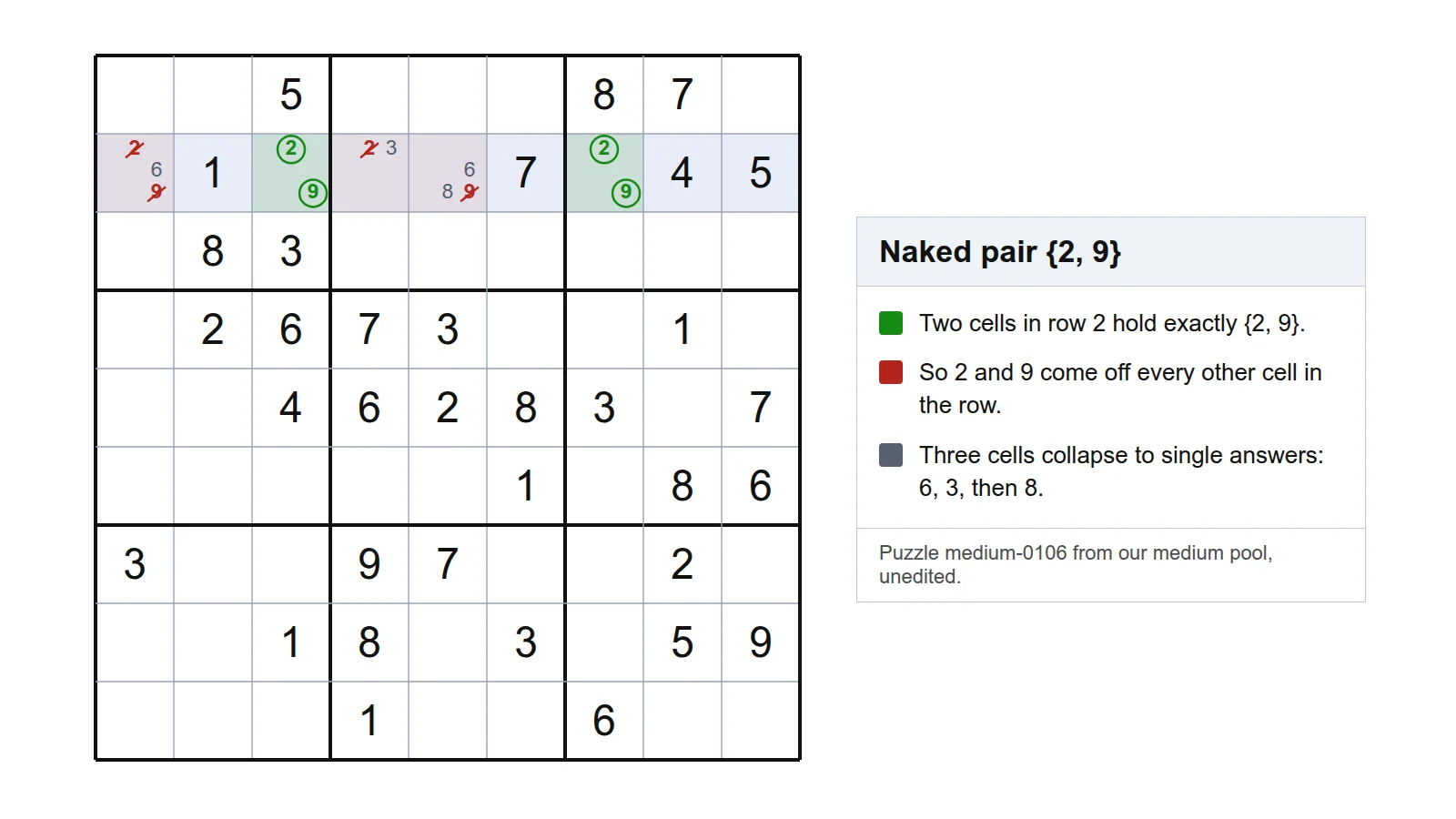
This example is worth slowing down for, because one pair cracks the entire row. Row 2 has five empty cells with candidates {2,6,9}, {2,9}, {2,3}, {6,8,9}, and {2,9}. The two {2,9} cells form the pair. Remove 2 and 9 from their neighbors and the {2,6,9} cell becomes 6, the {2,3} cell becomes 3, and with the 6 placed, the {6,8,9} cell becomes 8. Three placements from one observation.
Try it on the real grid
| 5 | 8 | 7 | ||||||
| 1 | 7 | 4 | 5 | |||||
| 8 | 3 | |||||||
| 2 | 6 | 7 | 3 | 1 | ||||
| 4 | 6 | 2 | 8 | 3 | 7 | |||
| 1 | 8 | 6 | ||||||
| 3 | 9 | 7 | 2 | |||||
| 1 | 8 | 3 | 5 | 9 | ||||
| 1 | 6 |
Work it yourself
This is the same puzzle as the diagram, medium-0106 from our medium pool. Copy it onto a blank grid or work from the screen: write the candidates for the five empty cells of row 2, find the pair, and watch the row fall.
Then keep going. Singles alone can finish this grid from the printed state, so the pair is a shortcut rather than a requirement, and that makes it a low-stakes place to practice reading marks.
Hidden pair
The mirror image: two digits whose only two possible cells in a unit are the same two cells. Those cells must hold that pair, so every other candidate written in them can be erased. Hidden pairs are harder to see because the pair cells are cluttered with extra marks. To find them, track one digit at a time across the unit; the clutter stops mattering once you only care about where the 4s can go.
Naked and hidden triples
Pairs extend to threes. Three cells in a unit sharing the same three candidates (each cell may hold only two of them) lock those digits, clearing them from the rest of the unit. Hidden triples are the reverse and are genuinely hard to spot on paper. We would not go looking for them below expert level; in our pools, puzzles that need triples are concentrated in the expert and extreme ranges.
Pointing pairs and triples
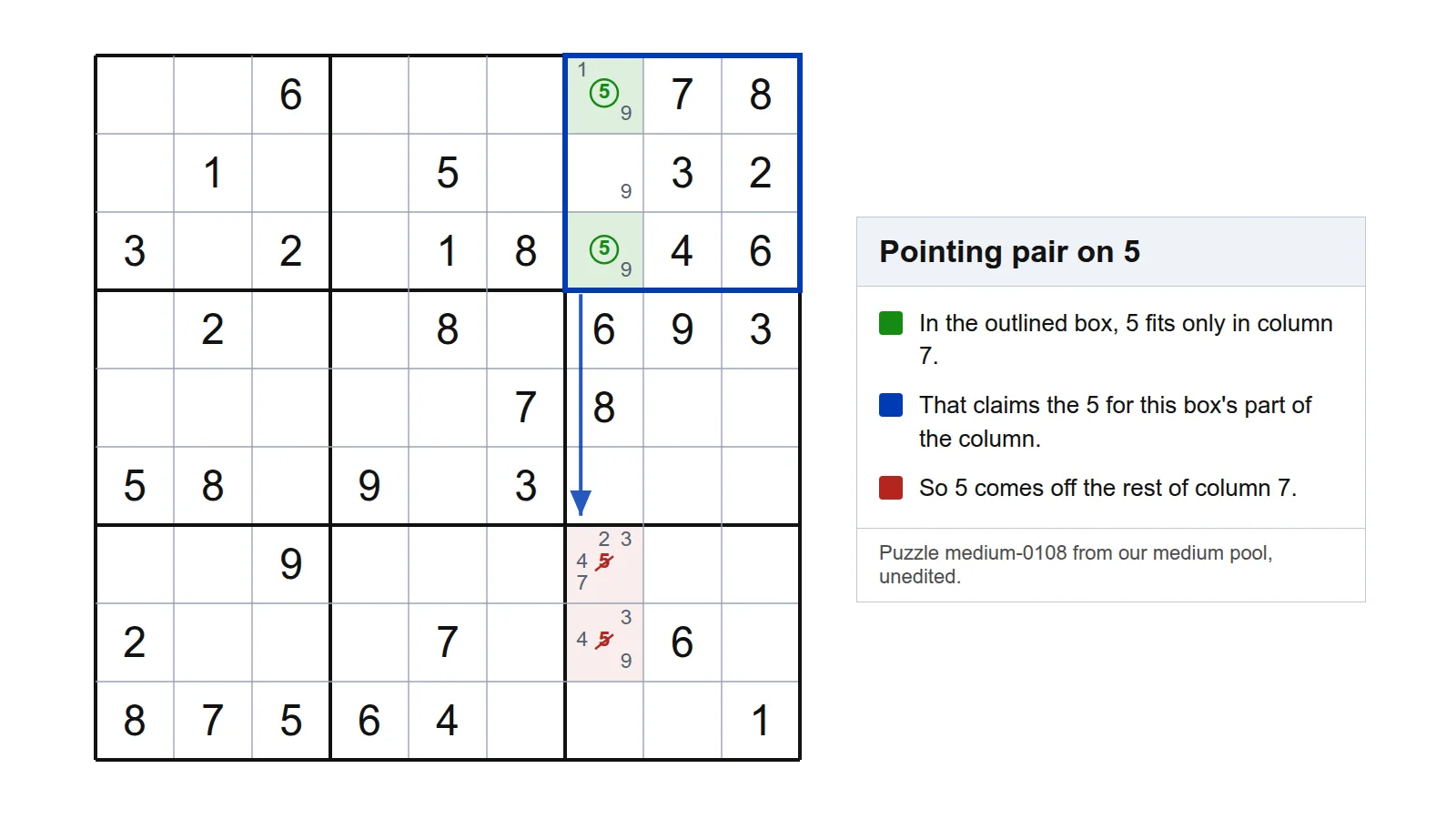
When a digit's only candidates inside a box line up in a single row or column, the box claims that digit for that line. The digit can be removed from the rest of the line outside the box, even though you have no idea which of the two or three cells it lands in.
Box-line reduction
The same logic run in reverse: if a digit's only candidates within a row or column all sit inside one box, the digit must be in that box on that line, so remove it from the box's other cells. In our experience this is the most underrated technique on the list. Solvers learn pointing pairs and stop, and then blame a stall on bad luck when the grid was waiting for the mirror move.
Advanced Techniques: X-Wing and Beyond
Advanced patterns span multiple boxes and are read almost entirely from pencil marks, which is why the marking discipline above matters. Their payoff is eliminations that no smaller pattern can reach.
X-Wing
Find two rows where a digit has exactly two possible columns, and the columns match. The digit must occupy diagonal corners of that rectangle, one per row, one per column. Either diagonal works, and both diagonals use up both columns, so the digit disappears from those columns in every other row.
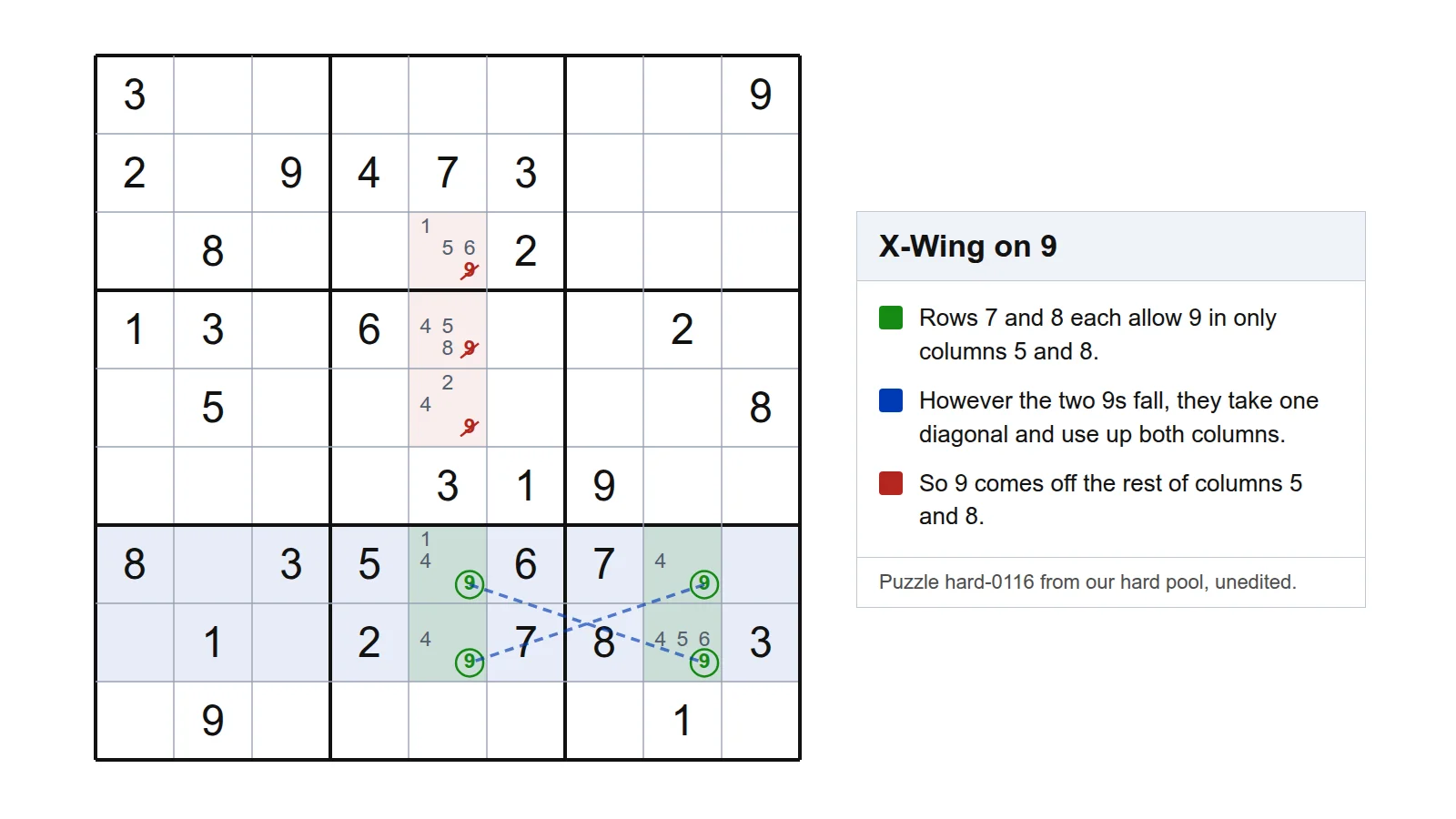
X-Wings normally emerge mid-solve, after singles and pairs have thinned the marks. The example above is unusual: when we scanned our hard pool, hard-0116 had this one sitting on the printed grid before a single placement. If you want to see it in the wild, that is the puzzle to print.
Swordfish
An X-Wing on three lines. One digit confined to the same three columns across three rows can be cleared from those columns everywhere else. On paper, look for rows where a digit has only two or three marks; two such rows suggest an X-Wing, three suggest a swordfish. Jellyfish, the four-line version, exists but you can solve for years without needing one.
XY-Wing
Three cells with two candidates each, linked like {X,Y} - {Y,Z} - {X,Z}. The middle cell (the pivot) sees both others. Whichever way the pivot resolves, one of the outer cells becomes Z, so any cell that sees both outer cells cannot be Z. This is the first technique on the page that chains cells together, and it is the gateway to everything harder.
Skyscraper and unique rectangle, briefly
A skyscraper is a broken X-Wing: two rows where a digit appears twice, columns matching on one side only. The two "roof" cells cannot both be false, so cells seeing both lose the digit. A unique rectangle exploits the fact that a proper puzzle has one solution: four cells forming a rectangle across exactly two boxes must not end up with the same bare pair in all four corners, and you may delete candidates that would create that deadly pattern. Since every puzzle we publish is verified to have a unique solution, uniqueness arguments are safe on our grids.
Chains and coloring
Past this point lie coloring, remote pairs, and forcing chains: following a candidate's implications until it proves or disproves itself. They work on paper with margin notes, but honestly, this is where screen solvers have an edge. Our take: a paper solver with everything down through XY-Wing can finish the large majority of published puzzles, including most of our extreme pool, and SudokuWiki's strategy families catalog the rest in depth when you want it.
What Our Difficulty Data Shows
Our generator grades puzzles by the techniques their solution paths require (clue count alone says little), so we can put numbers on the ladder. The table below comes from 150-puzzle samples of each 1,000-puzzle pool: the givens you get, and how often naked and hidden singles alone finish the grid.
| Difficulty | Givens | Solved by singles alone | What to bring |
|---|---|---|---|
| Easy | 40 | 99% | Naked and hidden singles. Pencil marks are optional. |
| Medium | 34 | 89% | Singles, plus an occasional naked pair or pointing pair. |
| Hard | 30 | 57% | Pairs and pointing eliminations become routine. |
| Expert | 27-28 | 31% | Triples, box-line reduction, and X-Wing territory. |
| Extreme | 24 | 24% | Wings, swordfish, and long candidate work. |
Read the second column as a promotion test. If singles finish 99% of easy grids and you still stall on them, the gap is in scanning habits, and no new technique will close it. If you clear medium reliably but hard grids stop you 40% of the time, that is the pairs-and-pointing tier telling you to practice it. Print puzzles with solutions while climbing, and check only after committing to an answer.
One more number worth knowing: the count of naked singles sitting open on the printed grid averages about seven on easy, four on medium, two on hard, one on expert, and under one on extreme. When an extreme grid offers you nothing to write in the first minute, the grid was built to open that slowly; expect your first progress there to come from an elimination.
A Checklist for When You Are Stuck
Stalls have causes. Run this list in order, and note that the expensive techniques are at the bottom; in our experience the fix is in the first three steps far more often than pride wants to admit.
- Recount your most-placed digit
Pick whichever digit already appears seven or eight times and cross-hatch it through every box it is missing from. A digit with two cells left almost always finishes.
- Find the fullest row, column, or box
A unit with seven filled cells has two blanks and two missing digits. Check each blank against its crossing units; one of the two placements is often forced.
- Audit your pencil marks
Look for any cell holding a single mark you forgot to promote, and any digit with a single home left in a unit. Stale marks hide finished deductions.
- Hunt pairs, then pointing pairs
Two cells in one unit with the same two candidates strip those digits from the rest of the unit. Then check each box for a digit confined to one row or column.
- Walk one digit through all nine boxes
Choose a digit with five or six placements and ask, box by box: where can it still go? This surfaces hidden singles that cell-by-cell reading misses.
- Rule out an error before going deeper
Scan every unit that touches your recent placements for duplicates. If something looks off, enter the givens into the Sudoku solver and compare.
- Put the page down
Ten minutes away resets your scanning. Nine times out of ten the move you were missing turns out to be a plain single.
For step six, the Sudoku solver accepts any grid and shows the completed solution, which lets you verify a suspect placement without spoiling the rest of the puzzle: check the one cell you doubt and look away.
How to Solve Faster
Speed is scanning order, not quick hands. Competitive solvers finish easy grids in two to four minutes with the habits below, and all of them transfer directly to paper.
- Count before you scan. The digit with the most givens finishes fastest, and each placement you make tightens the next one.
- Skip pencil marks entirely on easy grids. With around seven naked singles open at the start, marking candidates costs more time than it saves.
- Sweep in bands. Cross-hatch a digit through three horizontal boxes in one pass instead of treating each box as a separate job.
- Say the missing digits out loud or in your head, in order. Verbalizing '2, 5, 9 left' keeps you from re-deriving the same list.
- Use the 45 subtraction on any unit with one blank instead of scanning for the missing digit.
- Drill with compact sheets. Four puzzles per page and a timer per grid shows your average dropping within a week.
For drills, print a four-per-page sheet of easy puzzles, or take the daily Sudoku at the same difficulty every morning and track your time. Consistency against the same difficulty is what makes the trend visible.
Mistakes That Cost the Most Time
These are technique-level mistakes, one tier up from the rule errors covered in the beginner guide. We see every one of them in feedback from solvers who print our grids.
| Mistake | Better habit |
|---|---|
| Filling pencil marks into every empty cell before scanning | Place all available singles first. Marks belong only in the cells that survive that pass; on easy grids you may never need them. |
| Leaving stale marks after a placement | Every placement invalidates that digit's marks in three units. Clean them immediately or your next 'naked single' may be wrong. |
| Treating a two-candidate cell as a coin flip | Bi-value cells are raw material for pairs, XY-Wings, and chains. Park them and come back armed, do not guess. |
| Hunting X-Wings while a hidden single sits open | Run techniques from cheap to expensive: singles, pairs, pointing, then fish. Expensive patterns are rarely the actual blocker. |
| Trusting a mark you cannot re-derive | If a candidate looks suspicious, re-check it against its row, column, and box. Copying an early mistake forward ruins more grids than hard logic does. |
| Solving in pen with no correction system | Cross out rather than scribble, keep candidates in the margin, and keep a blank grid nearby to restart a corrupted section. |
Watch the Techniques in Motion
Static diagrams show the pattern; watching someone's scanning order shows the rhythm. This walkthrough demonstrates candidate work and set-based eliminations on a real grid, and pairs well with the intermediate section above.
If the embed is blocked, open the walkthrough on YouTube.
Sudoku Tips FAQ
- Is there any trick to solve Sudoku?
- No single trick solves every grid, but two moves finish most puzzles: naked singles (a cell with one remaining candidate) and hidden singles (a digit with one remaining home in a row, column, or box). In 150-puzzle samples from our own pools, those two techniques alone completed 99% of easy puzzles and 89% of medium puzzles. Harder grids add pairs, pointing eliminations, and eventually X-Wings.
- What is the 45 rule in Sudoku?
- Every row, column, and 3x3 box sums to 45, because 1+2+3+4+5+6+7+8+9 = 45. In a unit with one blank, subtract the sum of the eight filled cells from 45 and you have the missing digit without scanning anything. The rule does most of the work in Killer Sudoku, where cage totals are combined with the 45 total of each row, column, and box.
- What is the swordfish technique in Sudoku?
- A swordfish is an X-Wing stretched to three lines. If one digit is restricted to the same three columns across three different rows, the digit must take one of those spots in each row, so it can be removed from those three columns everywhere else. To spot one, scan your pencil marks one digit at a time and note rows where that digit has only two or three possible cells.
- What is the 3x3 rule in Sudoku?
- Each of the nine 3x3 boxes must contain the digits 1 through 9 exactly once, on top of the row and column rules. The box rule is the one beginners forget: a placement can be legal in its row and its column and still repeat a digit inside the box. Checking all three units before writing a digit prevents most wrong entries.
- Can you solve hard Sudoku without guessing?
- Yes. A properly made puzzle has exactly one solution reachable by logic, and every puzzle on this site is checked by a solver to confirm a unique solution before it is published. When a hard grid feels like it demands a guess, the missing step is usually a pointing pair, a box-line reduction, or an X-Wing rather than trial and error.
Keep Practicing
Techniques stick through repetition at the right difficulty, so pick the level the data table points to and print a batch. The Sudoku generator lets you set difficulty, paper size, puzzles per page, and answer pages in one download.
- Medium printable Sudoku: the right daily grind while learning pairs.
- Hard printable Sudoku: where pointing pairs and box-line reduction earn their keep.
- Daily Sudoku: one fresh puzzle per difficulty every day, for timed practice.
- Sudoku rules: the short reference, if a fundamentals question came up mid-solve.
- Sudoku strategy: the condensed strategy summary page.
For theory beyond this page, SudokuWiki documents every named technique with interactive examples, and Numberphile's Sudoku video is a good look at the math underneath the grid.